Architecture & Strategy
The Hidden Price Tag of "Free" Open Source: When Growth Becomes a Panic
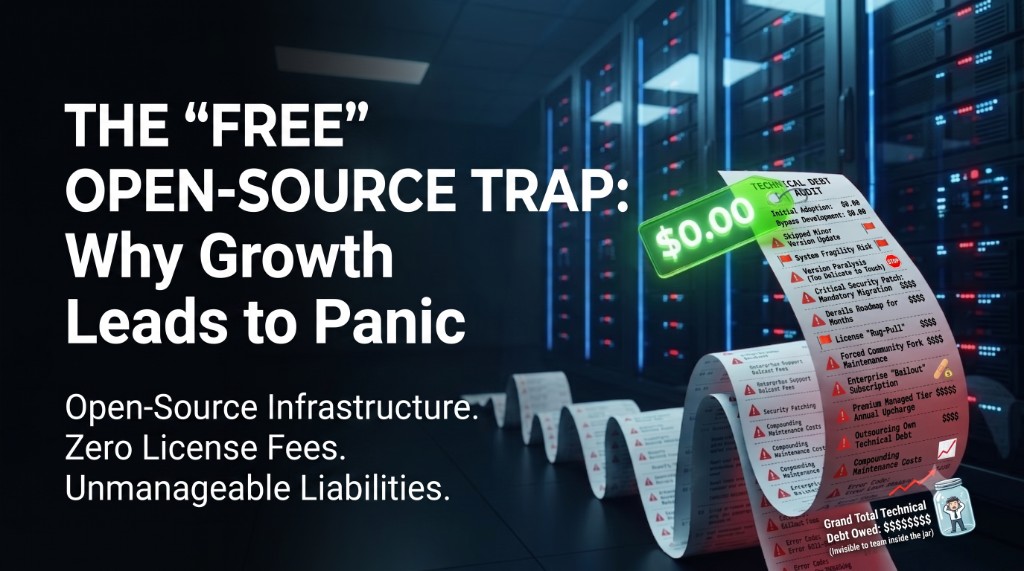
The greatest magic trick the tech industry ever pulled was convincing us that open-source infrastructure is “free.”
When you are a young organization, spinning up a new open-source database, message broker, or monitoring stack feels like a massive win. You bypass months of development time and get straight to building your core product. It costs zero dollars in licensing fees.
But as your organization scales, the reality of that “free” infrastructure begins to set in. If you let your open-source architecture just “flow along” without strict governance, it quietly transforms from an asset into a massive liability.
Eventually, you hit the wall. A routine feature addition, a necessary refactor, or a spike in traffic triggers a complete architectural panic. Here is exactly how that panic usually unfolds—and how to stop it before it starts.
The Three Traps of Open-Source Sprawl
1. Version Paralysis (The “Too Delicate to Touch” Trap)
We have all seen this system: the critical open-source component that has not been updated in three years.
Why? Because early on, the team skipped a few minor version updates to focus on shipping features. Now, the system is so delicate, and the breaking changes in the new version are so vast, that nobody wants to risk touching it.
“If it ain’t broke, don’t fix it” quickly devolves into, “If we touch it, the whole platform goes down.” When a critical security patch is finally required, or you need a feature only available in the newest release, the team is forced into a terrifying, high-risk migration that derails the entire product roadmap for months.
2. The License “Rug-Pull”
Over the last few years, the industry has seen a massive shift in how open-source companies monetize.
You build your entire data pipeline or infrastructure around a core, open-source technology. Then, the maintainers change the licensing model overnight. Suddenly, you are staring down a legal and financial nightmare. You are left wondering which direction to go: do you dedicate 10,000 engineering hours to ripping it out and replacing it? Do you switch to a community fork and pray it gets maintained? Or do you take the most expensive route…
3. The Enterprise Subscription Bailout
When the infrastructure becomes too brittle to maintain, or the license changes, organizations often panic and look for the fastest, easiest way out.
Enter the enterprise subscription.
Instead of addressing the underlying architectural rot, leadership simply writes a massive check to a vendor for a managed enterprise tier. It feels like a quick fix, but you are often just slapping a very expensive band-aid on a structural wound. You are paying a premium to outsource the pain of your own technical debt, rather than actually consolidating and resolving it.
The “Inside the Jar” Problem
Why do brilliant engineering teams let this happen? Because you cannot read the label from inside the jar.
When your engineers are in the trenches—focused on sprint deliverables, bug fixes, and keeping the lights on—they cannot see the macro-level architectural drift. The compounding interest of open-source maintenance is invisible until the day it bankrupts your engineering velocity.
This is exactly why having a trusted, outside set of eyes is critical. Just like you wouldn’t audit your own company’s finances, you shouldn’t rely solely on the people who built the system to identify its structural risks.
You need an external advisor who can objectively look at your open-source footprint and tell you where your technical debt is quietly accumulating compound interest.
The Actionable Takeaway: Start Your Audit Tomorrow
You do not need to wait for a panic to start taking inventory. In your next engineering leadership meeting, start mapping your open-source dependencies. Pick your top five most critical open-source infrastructure tools and ask three questions:
- How many versions behind the current release are we?
- Has the licensing model changed since we adopted it?
- If the core maintainers abandoned this project tomorrow, what is our exact migration plan?
If you don’t know the answers, your “free” infrastructure is already costing you more than you think.
About Ted Possible
Ted is the CEO at Proserveability and an active champion for developer-first infrastructure. He writes extensively about systems engineering, observability, and the future of data architecture.
Follow Ted on LinkedIn →